How To Create A Seamless Facebook Profile And Cover Photo
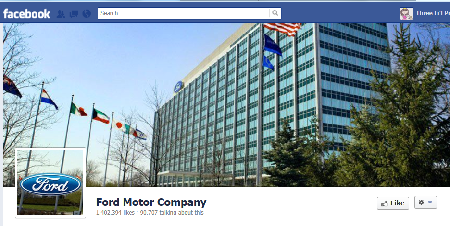
Ford on Facebook

Ford on Facebook with matching cover photo and profile image.

A matching Facebook cover photo and profile picture looks professional and exciting.  Look at the Ford one here – see the large image becomes the background behind the smaller logo picture?  Cute!

You can do so many things with it such as making your Facebook followers laugh or just to make your profile look professional. But how do you line up the two images and make it work? Read on.

How to line up Facebook cover photo with a profile picture

1. Screenshot your Facebook profile page: The first step is to take a screenshot of your profile page for size reference. Paste this screenshot into  PowerPoint or a similar programme where you can CROP the screenshot. We’ll be using our client, Rowperfect, as an example:
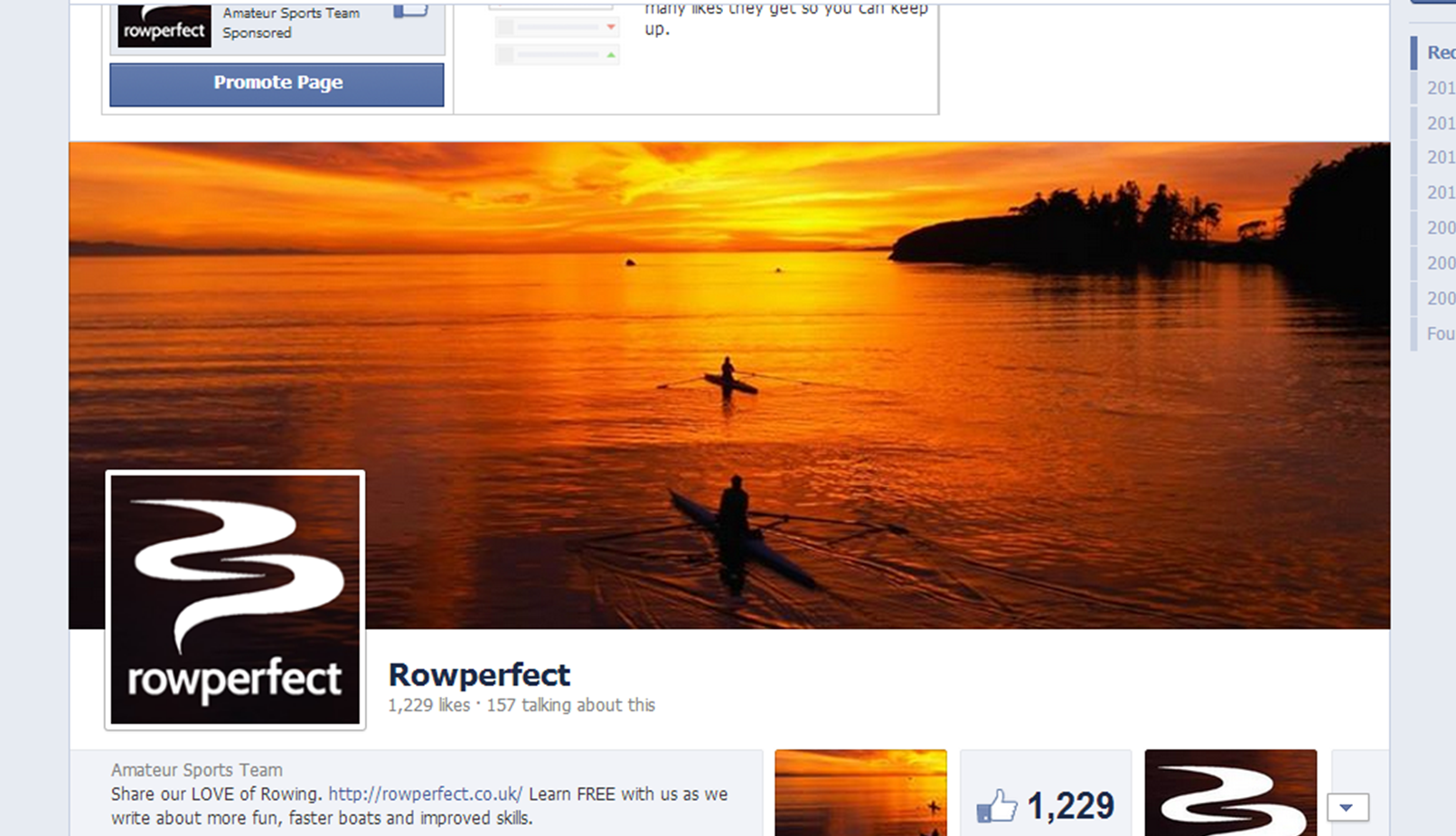
Screenshot of Rowperfect Facebook page

Screenshot of the Rowperfect Facebook page

2. Crop your chosen picture into two images: now that you have your profile screenshot and have pasted it into  PowerPoint you can begin cropping your desired image. Detailed instructions follow this image…follow steps 1-4 frame by frame below.cropping
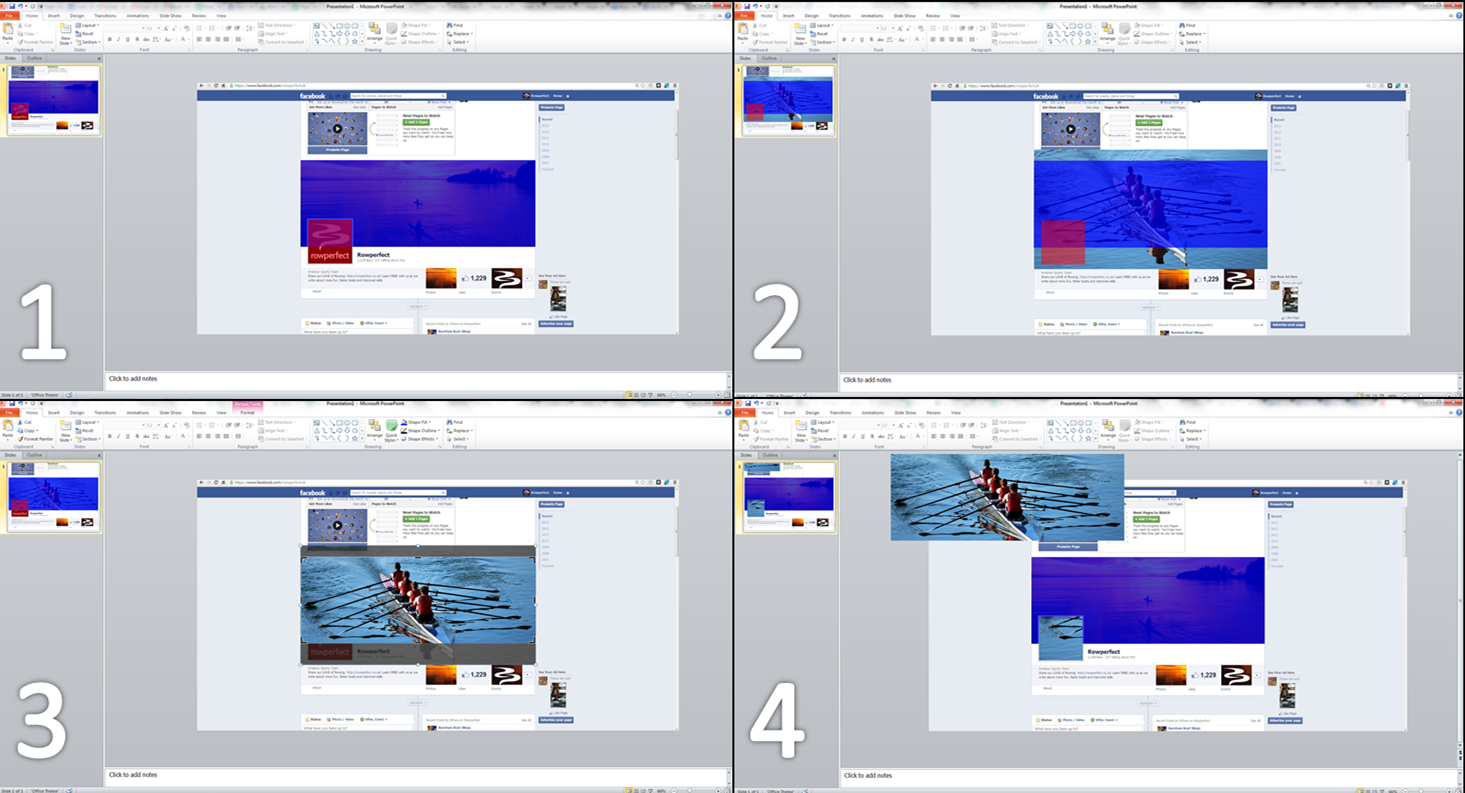
  • FRAME 1: mark your cover photo and your profile photo. The blue rectangle we’ve created represents the cover photo size area and the red square represents the profile picture. Remember to paste the screenshot exactly as it is and do not re-size it, even though it is larger than the PowerPoint work area.
  • FRAME 2: import the image you want as your combined profile picture and cover photo. Then re-size it so it is as big as the blue and red rectangle combined. Line it up as you wish.
  • FRAME 3: duplicate your now re-sized imported image, place it in the same location as its original and crop your imported image and its duplicate to be the size of the blue rectangle and red square respectively.
  • FRAME 4: now you have your two images, save the big one as COVER PHOTO and the smaller square one as PROFILE PICTURE.

3. Place them on your Facebook profile page: now you have your two images you can place the PROFILE PICTURE image on your Facebook profile picture and use the COVER PHOTO image as your Facebook profile cover. If all is done correctly your Facebook profile cover photo and profile picture will now line up together and look flash, just like the Rowperfect Facebook page!

Screenshot of Rowperfect Facebook page

Be creative: more interesting ideas

Here are a few ideas we found that might spark some inspiration for you… speech bubbles, a cartoon bird house, multiple images overlaid or a camera icon.  Be creative.
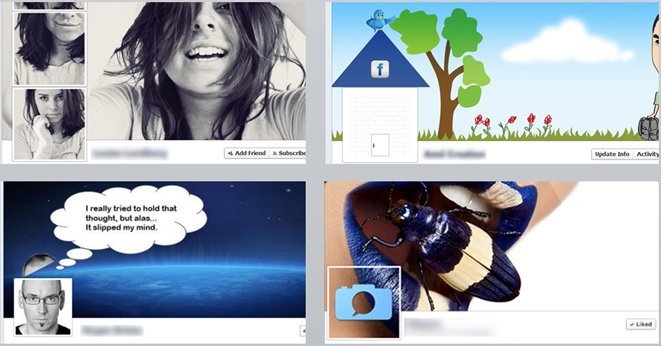
ideas

Facebook profile picture ideas and improvements

The Top 5 most popular articles of all time

How To Hire An Expert (When You Aren’t One) Seminar

No related posts.

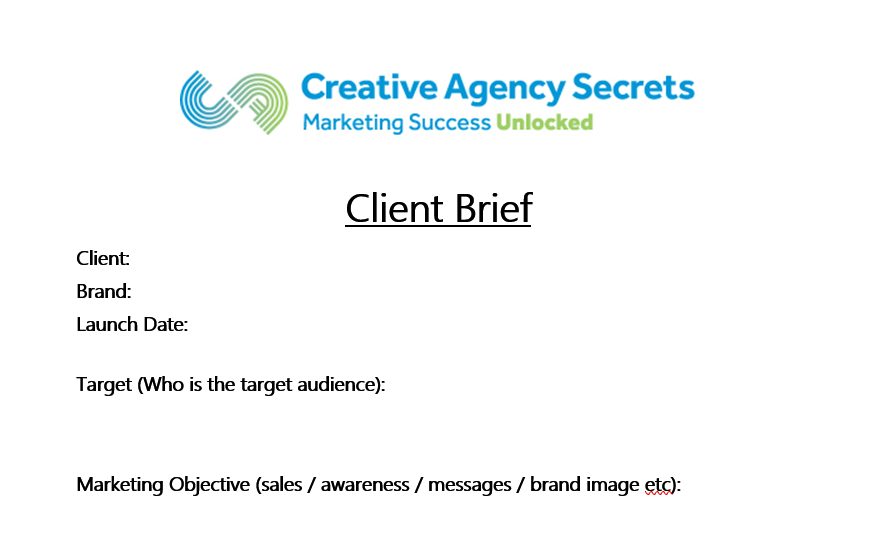
What Does A Client Brief Look Like?

Thanks to Dawn who wrote in asking “What does a client brief look like?” 

Let us help you out.

What to do when hiring an agency

If you sub-contract your marketing to an agency or to freelancers, you want to be sure that you pay for and get good quality work.

A lot of the quality of output is due to high quality input.  By that I mean, briefing documents.  If you can explain clearly what you want, how you want it done and timeframes, you are far more likely to get high quality work back.

We use Upwork and People Per Hour to find freelancers and expert sub-contractors.


Ask the freelancer to write back

For briefing we always give a lot of detail and we also ask the freelancer to write back with answers to our questions.

We choose these carefully in order to show us that THEY have read the brief.

  • Please tell me what access permissions you need before you start the job

And we also ask them open questions whose answers tell us if they understand the scope, how they would approach the job and allow us to assess how good their English is.

  • Estimate how long the job will take
  • Tell me what problems you anticipate

Below is a template document which we use when we receive instructions to do some marketing for our clients. You can download it from the link.

Each sub-heading is self explanatory – as a client you should fill in each section as clearly as possible and then send it out to the agency or agencies you want to work with asking them to send you price quotations.

Alternatively, you write longhand what you want and the agency will fill in the gaps in the document.  Then you should approve it before instructing the work.

DOWNLOAD Master Client Planning Brief Template

The Top 5 most popular articles of all time

How Online Fantasy Sports Companies Market Their Platforms?

Online fantasy sports are experiencing huge growth and are even rivaling online betting platforms. For those who don’t know, online fantasy sports platforms allow users to create fantasy sports teams and join competitions to potentially win cash prizes.

For example, users can create their own NBA basketball lineup packed full of stars such as LeBron James, Stephen Curry and Kyrie Irving, and then enter a league against other players to see how their teams match up. As the real life result roll in, scores are calculated based on your team selection, and your league standing is based on this score.

Due to the huge boost in popularity of online fantasy sports, their marketing techniques have had to improve and diversify. Popular platforms such as DraftKings, FanDuel, and PlayOn have to compete with each other and try to bring in customers through clever marketing. DraftKings is currently on top, with bettingsites.me.uk reporting that 50.6% of all players currently use the app.

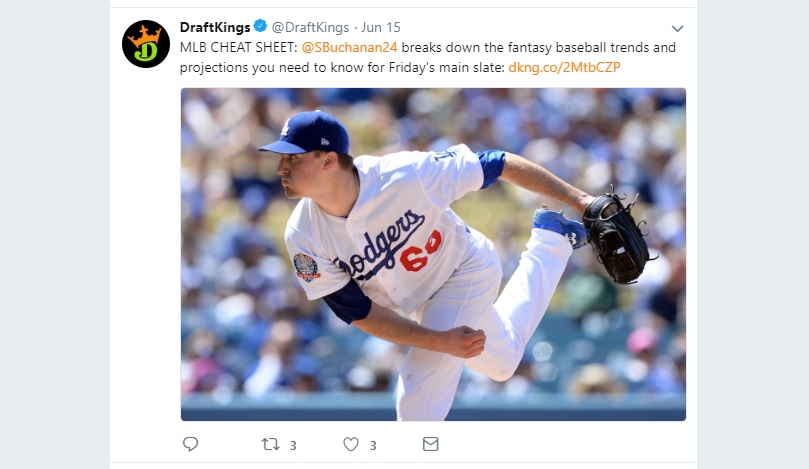
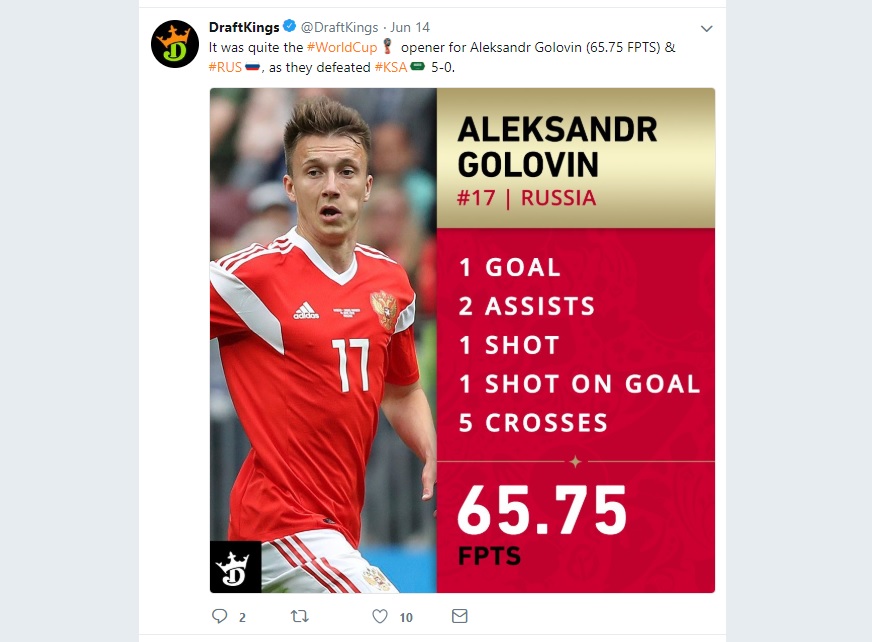
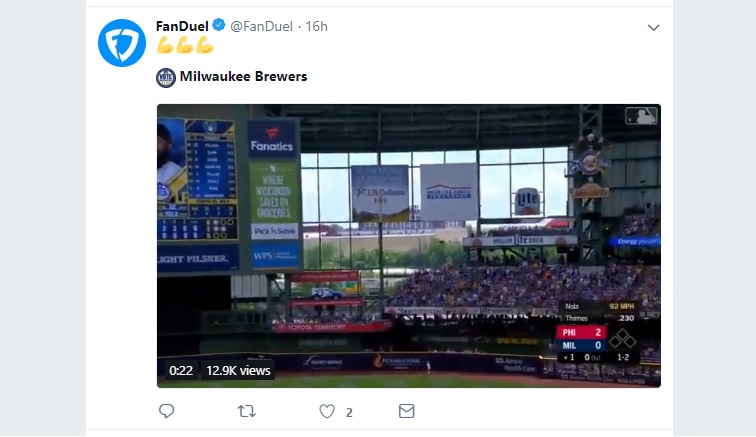
Social media are playing a huge role in fantasy sports marketing. Both FanDuel and DraftKings have a huge following on Twitter, for example (FanDuel – 212k followers, DraftKings – 244k followers), and use this network to post game highlights and interact with customers.

If you scroll through DraftKings’ Twitter feed, you can see it posting videos of MLB games and clips, uploading player profiles of top sporting personalities such as Cristiano Ronaldo, and even cheat sheets to help its user base improve their fantasy teams.

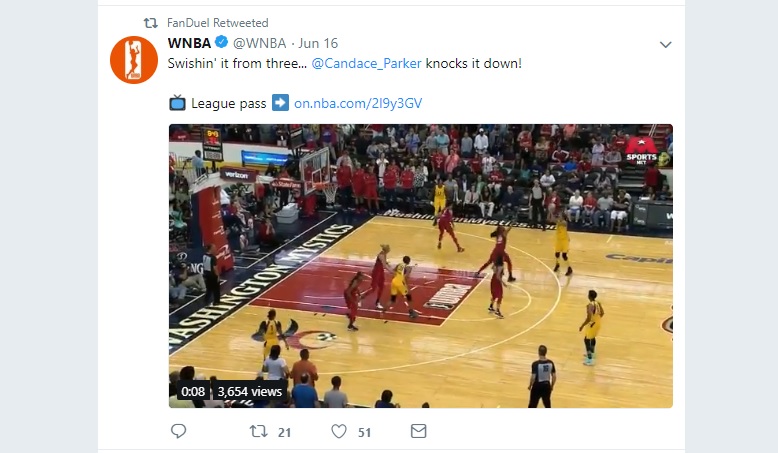
FanDuel alternatively regularly post WNBA highlights, show awesome MLB home runs, and also funny sports bloopers and memes. All of this gives content to its users and helps get them excited about the world of sport, as well as encourage interaction with their respective fantasy sports platforms.

Affiliate marketing is also hugely important for online fantasy sports platforms. Both DraftKings and FanDuel operate an affiliate program through which customers can gain commissions. In essence, a customer promotes the fantasy sports platform by using a special hyperlink. If someone clicks on this hyperlink and registers an account, the customer gains a small fee.

This is a clever form of marketing. The fantasy sports platform doesn’t really have to do anything and it benefits from increased exposure and more customers; all it has to give in return is a small percentage fee.

These are just two examples of fantasy sports marketing and there are many more. It is clear that marketing plays an important role in the promotion of fantasy sports and that it allows platforms such as DraftKings and FanDuel to gain a competitive edge in this ever increasing market.

The infographic below offers further insight into the world of fantasy sports:


How To Introduce A Business By Email

Connecting two compatible businesses with each other can be one of strongest networking tools for you and other businesses. By connecting the groups, not only are you solidifying your own network, but also helping the two businesses who may be able to benefit each other.

But often times this can be difficult over email.

In my networking group, we’re working hard to make it really EASY for members to introduce each other to new prospects and new clients.

I was asked by the group to help coach them in the best way to write an introduction that others could use.  So let’s say you wanted to introduce my firm to another business. Here’s how you would do it.


Hi [their name],
I just wanted to connect you with Rebecca from Creative Agency Secrets. I know you were interested in increasing your business’s online presence, and I’m sure they’ll be able to help.
Creative Agency Secrets is an expert in marketing and promoting businesses using traditional and online methods.  They work as the outsourced marketing team for busy businesses doing marketing that starts conversations and leads to sales.
I have seen their work for [name a client] and used them for my own business to write the copy on our website About Us page.  And I’ve also recommended them several times and had great feedback especially about their careful attention to detail.
I will leave you two to connect – I’ve spoken to you both about each other and shared your emails and phone numbers below.
[both parties’ contact information]
Best,
[Your Name]

The 5 elements of an effective email introduction

  1. Introduce: explain why you sent the email
  2. Start: with their one-liner…. who are they and what do they do
  3. Build: with an example of their work for someone you both know, preferably.  If you can’t say you have worked personally with them, a mutual acquaintance is a positive reinforcer.
  4. Memorability: Add an anecdote that describes your experience – if you can make it funny, cute or WOW that’s best but not strictly necessary.
  5. End: Include all the information they need to continue a dialogue without you….
    We plan on creating a shared document for everyone so they can cut/paste the text into emails for business referrals for new business development.

    The best introductions are when you’ve spoken personally to both parties.  NOTE not emailed, spoken….

    The Top 5 most popular articles of all time

3 Takeaway Tips: Building an SEO strategy for Living Goodness

Anyone should know that to establish a good online brand presence, you need a good Search Engine Optimisation (SEO) strategy. Keywords are a main part of that strategy – they’re more than just using the right tags to find relevant blog posts – they help boost your business’ search results so your website gets more traffic.

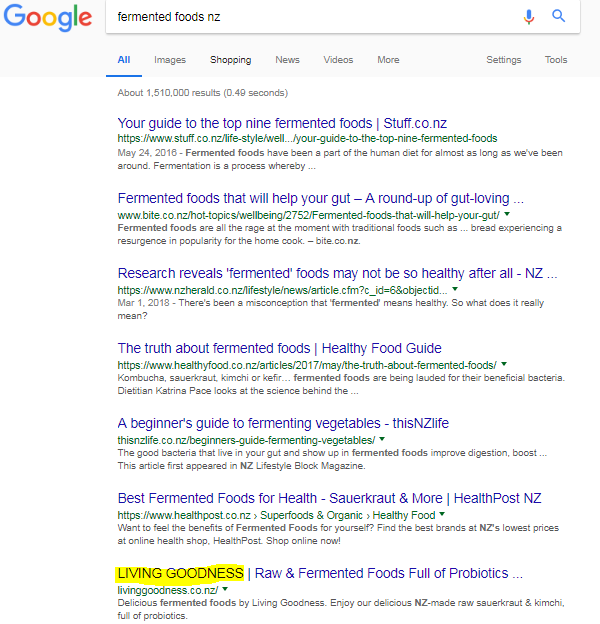
Last year, we helped Living Goodness develop an SEO strategy that saw them appear on the front page! And to top off the cake, it was also the first time that Living Goodness ranked higher than a competitor.

living goodness rankings

Seventh place! Not too shabby.

In this blog article, I’ll show you three key skills that we utilised for their SEO strategy, and show you how you can put them to work on your own business.

1. Identify which keywords you need

The keywords that you choose for your SEO strategy should fall into three categories:

  • Keywords you’re currently ranking for
  • Keywords you wish to rank for
  • Other relevant keywords you should also consider

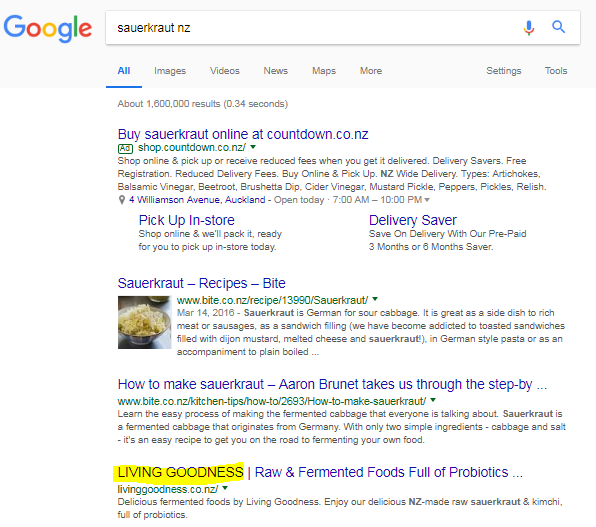
For example, Living Goodness were ranking for “fermented foods nz” (though they appeared on the second page of search results). They wanted to rank higher for this search term, and also wished to show up for “sauerkraut nz”.

ranking for sauerkraut nz

Which we achieved, by the way.

We went on to conduct our own research to find relevant keywords that would complement these. A handy tool that we turned to is called Answer the Public.

This allowed us to see what users were also searching for alongside the terms “fermented foods nz” and “sauerkraut nz”. We picked up key phrases and words such as “probiotics”, “raw”, “organic” and “kimchi” alongside many more. This also gave us a good starting point for blog article ideas.

2. Incorporate these keywords into existing content

Now that we had a lovely list of keywords, we needed to disperse them around different landing pages in a natural manner. For SEO purposes, there were key points that needed keyword boosting:

  • Landing page headings
  • Links
  • First paragraphs of content

These were just a few places where we implemented keywords into the existing content in a manner that was natural and flowed. Being a business that sells fermented foods, this wasn’t a problem. We also made sure we used a mix of these keywords because no one likes repetition (especially not Google!).

3. Help out your visitors with handy internal linking

Keywords aren’t the only way to boost SEO. There are many things that affect search engine rankings, and relevance is a big contender. If people aren’t spending long enough on your website and are bouncing away quickly (tip: check the bounce rate in Google Analytics), it may very well mean they’re not finding what they are looking for on your website.

Internal links are a great way to boost SEO and retain website traffic. If you aren’t linking to your products whenever you mention them, it’s a huge opportunity wasted. You also want to encourage a longer customer journey by suggesting other pages that are relevant.

For Living Goodness, we added links to their stockists page and social media handles on the recipes pages. This call-to-action prompted visitors to seek the closest stockist after reading a delicious recipe – “Are you running low on delicious sauerkraut or kimchi? Check out your local stockist here.” The social media links also encouraged visitors to share any of the recipes they’d followed. Being a foodie Instagram account, any photos using a Living Goodness product was free user-generated content, and of course, we were going to make the most of it!

Three simple tips that you can do yourself

As you can see, these tips are all very simple, easy and free to do. Hopefully, you’re able to apply them to your website straight away.

All these were tasks that we did as part of our SEO Starter Pack. It’s a comprehensive analysis of a website with actions to improve SEO and a recommended guide for next steps.

Search Console and broken website links

Has Google been sending you emails recently?  If you are the webmaster for your domain, you will be getting messages from Google Search Console as they find new errors on your website.

Search Console email text alert

The newly helpful Search Console Reports are good to get.  This is all part of a rollout of improved reporting.  Now you can take control of your own website SEO and won’t have to rely on bespoke or paid developer tools which you don’t want to buy.

What does Google’s email say?

Typically the standard email you receive is not written in plain English – this is tech-speak.  Let us help you decode it.

New Index coverage issue detected for site https://www.yourdomain.com

The Google is trying to be helpful.   So click through from the link supplied and see what the Search Console summary error page says.  There are quite a few possible variations – but here are some of the possible issues [Read the Google Support page]

  • Error
  • Warning
  • Excluded
  • Valid

Helpfully Google offers suggestions on how to research the issue you can test if the Robots.txt file is blocking, you can fetch the page as if you are Google [superb trick this], View the page as a search result and lastly, re-submit to the Google database.

Don’t worry – this isn’t terminal

If you have received this message you can research some how-to guides, blast through the Support guide or call us and we will help you fix it.  Remember Creative Agency Secrets will teach you how to do these fixes yourself, or we can do them for you.

I just checked the error from one client and found a lot of other broken links – use a broken link checker tool to find your priority pages.  It’s worth getting these sorted out – you know “nanny knows best.

Landing page

Four Major Mistakes You Don’t Want To Make With Product Landing Pages

Landing page mistakes, avoid errors on wordpress,

Product landing page mistakes to avoid

Designing a landing page is no easy task. There are many moving parts to consider, including copywriting, design, social media, and CTA placement. And with so many decisions to make (both big and small), it’s no wonder that mistakes can easily occur. In many cases, business owners fail to take the proper precautions to ensure their landing page is up to par, both in terms of design and functionality. Sometimes, they even let simple mistakes slide.

However, because humans have shorter attention spans than goldfish, you need to be able to capture their interest almost instantaneously. Within just a few seconds, a potential customer will move on to the next best thing because of an error you may have thought was trivial. Here are five mistakes you don’t want to make with product landing pages:

Choosing The Wrong Platform

There are many platforms available, and choosing the right one is crucial. WordPress is touted as one of the best lead-generating landing page platforms because it’s simple to set up, and creative freedom is nearly endless. You can choose from thousands of free and premium themes, and even install plugins like Elementor to build your product landing page with drag-and-drop functionality.

Then, there are other platforms designed to help you launch simple product landing pages, like LeadPages (which offers WordPress integration), Unbounce, and Instapage. These may offer a quicker set-up but are typically very limited in terms of design.

Think about your site goals before you choose a platform. For example, if you want to be able to incorporate certain features, like immersive photo galleries, you will need a platform that supports it. Or, if you think you’ll be using an independent designer or developer in the future, go with a platform that allows you to scale in that direction. Budget is another thing to keep in mind. If you’re just starting out or still growing your customer base, you might want to start with a cheaper option, like WordPress, which you can get for as low as $10 per month. Other lead-capturing landing pages cost anywhere from $30 to $200 per month, and even as high as $2,400 for platforms like HubSpot.

Stock Photography

Believe it or not, in most cases, people don’t like to see stock photography on product landing pages. It might be okay for your blog posts, but it requires special consideration for your landing page. A study conducted by MDG Advertising found that 67% of online shoppers consider quality images to be an integral part of their decision-making when it comes to purchases. The more vivid and authentic a photo is, the more likely they were to perceive ownership.

For software, beautiful screenshots are the way to go, and it would be fine to juxtapose humans with your software imagery. Sometimes, stock photography is the easiest way to mesh the two, but you might also want to add a high-res photo of someone actually using the software to add that extra touch of authenticity.

If you do use humans in your photography (whether stock photos or you your own), bear in mind that studies have shown that site visitors tend to look in the direction of the eyes that belong to the person in the photo. Therefore, you’d ideally want to have the person looking in the direction of your text.

No Clear CTA

Before you start working on your landing page, ask yourself, “What’s my main goal here?” One of the biggest mistakes people make with landing pages is cluttering it with too many options for the visitor. For example, it can be overwhelming to visit a landing page that wants you to read articles, sign up for a newsletter, purchase your newest product, watch a video, AND request a quote.

This doesn’t mean that you can’t have multiple points-of-purchase or ways to appeal to your potential customers. Instead, you should have a core goal that stands out above the rest, rather than blends in. Think about the singular action you want your visitor to take: this is called the call-to-action (CTA). Your call to action should be decently-sized, stand out, and be placed in the right area to attract the most attention. Use split testing software to help you choose between different types of CTA. This will help you choose the option that converts best.

Too Much Copy

Having too much copy on your landing page can be fatal. As previously mentioned, most people don’t have a very long attention span, and every small decision about your copy–from size to typography to color and word count–plays an important role. Too many words create information overload and dilutes the message you’re trying to get across.

Keep your sentences and paragraphs short and concise. Try to avoid using one of the pages to dominate the text. It’s best not to align left or right when you’re working on landing pages. Instead, you want to spread bite-sized bits of copy across the page evenly. You want your copy to be as scannable as possible, and clunky paragraphs make it very difficult to achieve this. For optimal results, try breaking up the text by using well-designed icons, mini-paragraphs, bullet points, color-coordinated sub-sections.


The (b)leading edge of Accountancy marketing

Sage publishes an annual survey of accountants attitudes – what’s interesting is that it is global and the summary report details some good findings about the profession.  It’s called The Practice of Now 2018 

As a marketer who works with professional services businesses, my reading highlights some big numbers in the research about artificial intelligence, fear of competition, lack of optimism and increasingly demanding clients.  The implications for marketing, I will cover at the end of this article.

10 take-outs from the Practice of Now 2018 report

  1. Clients are changing faster than accountants. – 42% of clients expect accountants to provide business advice.  This shows how frontline accountancy is in the mind of the client and how banks and business mentors have failed to take up the slack here, which is an opportunity for growth.
  2. Revenues rise as cloud accounting allows firms to be more productive.  56% of firms saw a revenue rise.  If your firm didn’t see this fee income growth – start to review your working practices.
  3. Practice Management in the cloud is at 53% adoption – clearly we are into the mainstream majority now.
  4. But confidence is lower – 40% feel less confident about the prospects for their practice.  Clearly Xero’s goal of putting accountants out of business is realistic and beginning to come true.
  5. Competition within the industry is more visible – are you buying up a practice from a retiring competitor?  Clients will go to an accountant who serves their needs – even to another city or country.  This is both a threat and and opportunity for new business development.
  6. Artificial Intelligence is helping free up administrative tasks and it’s more than just automation. Moving from data entry, email and diary management to higher value services is a no-brainer… but how to set it up is the challenge as these skills aren’t in-house and they may not be in the IT services organisations who work with accountants either.
  7. Most accountants are doing some workflow automation – 49% want to do more of it.  So the benefits are noticed (see 2 above).
  8. The language of accountancy is changing – “Tell me how much money I have” and “How much am I owed?” is SO refreshing compared to “debtors, creditors and accruals”.  From a marketing point of view, these messages are very powerful and simple – but does your firm use this language?
  9. Advisory services are wanted by 42% of clients – but if you don’t market & position the firm to capture this revenue, clients will go elsewhere.
  10. The BIGGIE – 67% of accountants say that cloud technologies make client collaboration easier. Phew, glad that worked out because it jolly well ought to be this way.

Should I worry about artificial intelligence?

If you’re not sure what A.I. could do for your business, start asking questions now.  Because we all understand automation in things like bank feeds, this is a very small part of the working practice move towards higher functionality for humans and lower functions for machines (or software robots).

The easiest way to understand the potential for AI in accountancy is this extract from the report

Candidates for automation already include assigning incoming bank statement entries with the correct nominal codes—via training the machine becomes able to predict what codes should be used—but in the near future the power of AI to learn means it will become involved with operations like analytics and report creation. For example, software will be able to predict a client’s cash flow based on the company’s previous behaviour. Based on self-generated data, AI will be able to make predictions and decisions. This isn’t limited to client data. By examining things like seasonality data, AI can help with practice management. AI and automation aren’t just desirable because they make life easier. Research has suggested that the tedium of repetitive tasks can lead to a high staff turnover, introducing additional costs for a practice such as recruitment and training. Automating these processes makes complete business sense.”

It goes on to say

“AI can flag the anomalies, saving time and resources, making the accountant more productive.”

Your strategic marketing pathway

And as a marketer, if I am advising a modern accountancy practice this is what they should be doing for strategic marketing.

Firstly get your brand positioning updated to reflect modern working.  Think Nena and Kim Wilde – “Anyplace, anywhere, anytime” and you’ll be on the right track.

How that branding plays out into your collateral, positioning, services and online profile should be straightforward.  The key is to get the strategy right first and the rollout should be clear.  You will need new keywords for SEO, your client communications will become driven by client preference and choice and your language will simplify and align with clients’ choices of words. 

Other than that, it’s marketing business as (un)usual for a modern accountancy practice.